
Concern Growing About The Western Snowpack
Even with headlines of extensive precipitation in several parts of the West this winter.
“We have been contending with unusually warm weather that has limited high elevation snow accumulations,” said USDA meteorologist Brad Rippey. “And in some ranges, contributing to near to below normal mountain snowpack so far this season. And as the western water season moves through its final weeks, concerns grow in some areas about available water supplies later in the year for crops, for pastures, and for communities.”

It is now past the midway point of the traditional western water accumulation season. The period between October 1st and April 1st is when western mountain ranges receive needed snowpack levels that when melted gradually over the spring and summer months, run off into regional water reservoirs. Rippey said these water supplies are vital to the many arid parts of the West.
“For some of the smaller reservoirs, what happens is if you get that precipitation in the form of rain, instead of snow,” Rippey said. “Water managers have to make some difficult decisions. They look at those reservoirs. There's always the potential of future heavy precipitation. You have to contend with the fact that there's going to be runoff from the higher elevations into those basins. And so you have to leave some room for runoff or future potential storms. And when that precipitation comes early and fills the reservoirs, managers have to let some of that water go straight into the ocean without being used for irrigation or municipal purposes. It's lost.”
You may remember December weather in the Pacific Coast States, a phenomenon known as atmospheric rivers. The catalyst behind a series of storms with heavy precipitation and in turn, flash flooding, debris flows, mudslides, and damages. Usually, such precipitation leads to snowpack accumulations in regional ranges such as the Cascades, Rockies, and Sierra Nevada. Only one thing, according to Brad Rippe.
“Despite all of the storms, we have been contending with unusually warm weather that has limited high elevation snow accumulations,” Rippey said. “[Leading to] a fairly disappointing overall snowpack situation in the West, but it's also highly variable.”
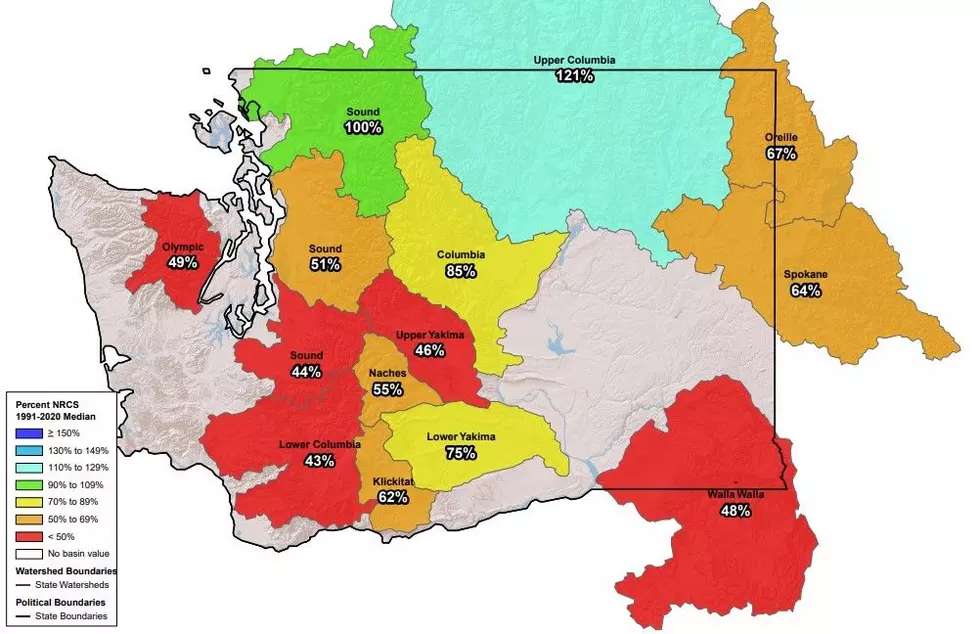
There is one area of the West where mountain snowpack and runoff potential both look promising in late January.
“The Northern Rockies, far enough north that the warmth hasn't really eaten into those snow accumulations. And so if you look at places like northern Idaho, western Montana, even extending into the eastern part of Washington state, snowpack is actually looking pretty good near or above average, and that bodes well for spring and summer runoff for major river basins like the Columbia, for example.”
The Sierra Nevada range, the primary water source for California agriculture and municipalities, is increasingly growing as a concern area for future water supplies after a promising start to its water season.

“There we managed to pile up more than 10” of water equivalency by the time we got into early January. Now that it has turned dry, we're starting to see those daily averages slipping a bit. We were effectively at normal in early January, but now here in mid-January, that is only about 80% of average for the date and only a little less than 40% of average for what we would expect to see pile up by April 1st.”
Yet the remainder of the West at the water season midway point.
“Is in pretty rough shape,” Rippey stressed. “And that means that these December temperatures, more than 10 degrees above average, have just eaten into the snowpack potential. And also for some of the inland areas, we just haven't seen that moisture transport beyond the Pacific Coast states in the western Great Basin. So, if you look at the Four Corners region, points east and south from there, snowpack is well under 50% of average. That less than 50% of average also extends to western Utah, the northern Great Basin, including northern Nevada, and also much of Oregon as well, even extending into the southern tier of Washington state. All those areas, less than 50% of average snowpack.”

As Rippy points out, there are still two months remaining in the western water season for mountain snowpack to accumulate and reach near or above normal levels. Yet regarding the remainder of January, above normal temperatures are expected through much of the region. And while precipitation is forecasted, the warmth will impact how much of that falls in the form of mountain snow and how much as rainfall. Western water managers in the coming weeks may be dealing with a balancing act regarding potential water supplies this year.
“If it turns dry or if we don't get the snow, then you might face a reservoir that's already half empty by the time we start the growing season,” Rippey added.
If you have a story idea for the PNW Ag Network, call (509) 547-1618, or e-mail glenn.vaagen@townsquaremedia.com
More From PNW Ag Network