
Why Has Drought Been Declared In Washington?
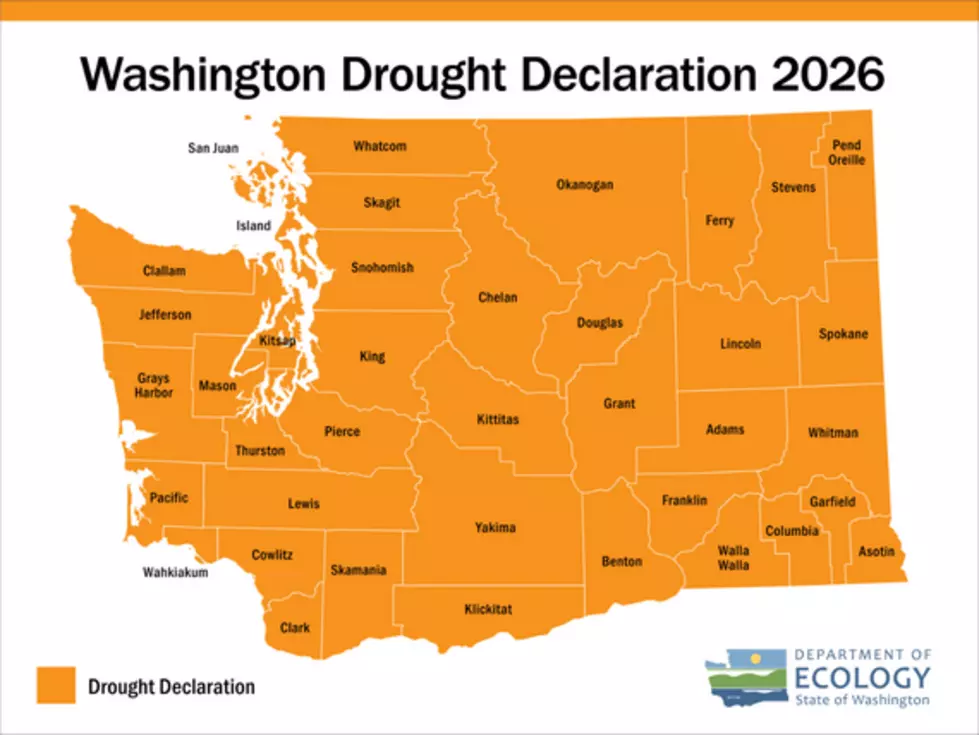
The Washington Department of Ecology said this spring’s drought declaration is based on science, not just dry weather headlines.
State law allows a drought emergency when water supplies are expected to fall below 75% of normal, and there’s risk to people, farms, fish, or the environment. Even after a wetter-than-normal winter, scientists say the unusually warm temperatures the Northwest experienced this winter caused much of the precipitation to fall as rain rather than snow.
The Snowpack Is Going, Going....Almost Gone
That means less mountain snowpack, the state’s natural water storage for summer. In the Upper Yakima Basin, for example, snowpack was just 9% of normal in mid-May, despite above-normal winter precipitation. Despite low snowpack, the basin actually had 109% of normal precipitation during the winter months.
“SNOTEL sites provide essential data used routinely for a number of purposes and interests including water supply forecasts, resource management, research, and even recreation," said Toby Rodgers with NRCS. “The SNOTEL network is a robust system of stations that are routinely maintained and updated in order to provide the most reliable data to all of the interested stakeholders.”
When Declaring Droughts, Ecology Looks To The Past And The Future
Ecology noted seasonal forecasts are another factor considered when determining whether the technical definition of drought will be met. Ecology gets its historical climate and seasonal climate information from the Washington State Climate Office at the University of Washington, or WASCO.
For the seasonal forecasts, WASCO scientists compile temperature and precipitation forecasts from the National Oceanic and Atmospheric Administration Climate Prediction Center and from national and international seasonal forecast models.
WASCO also monitors the status and forecasts for El Niño/La Niña in the tropical Pacific which can impact Washington weather. The weather and seasonal climate patterns that occur each year are put into historical context using long records of observations primarily from NOAA, but other federal agencies and universities as well. WASCO has developed multiple tools to analyze recent climate data.
“While not always relevant to monitoring for drought each individual season, longer-term climate projections are also provided by the Washington State Climate Office,” said Deputy State Climatologist Karin Bumbaco. “This year’s drought, for example, with a warmer than normal winter, near-normal precipitation, and much less snowpack than usual, is the mechanism for drought that climate models project will occur much more frequently by the 2050s.”
Ecology said the data and monthly water supply meetings are available on the statewide conditions page.
If you have a story idea for the PNW Ag Network, call (509) 547-9791, or e-mail glenn.vaagen@townsquaremedia.com
More From PNW Ag Network